
The Co-Listing Playbook: Best Practices for Shared Success

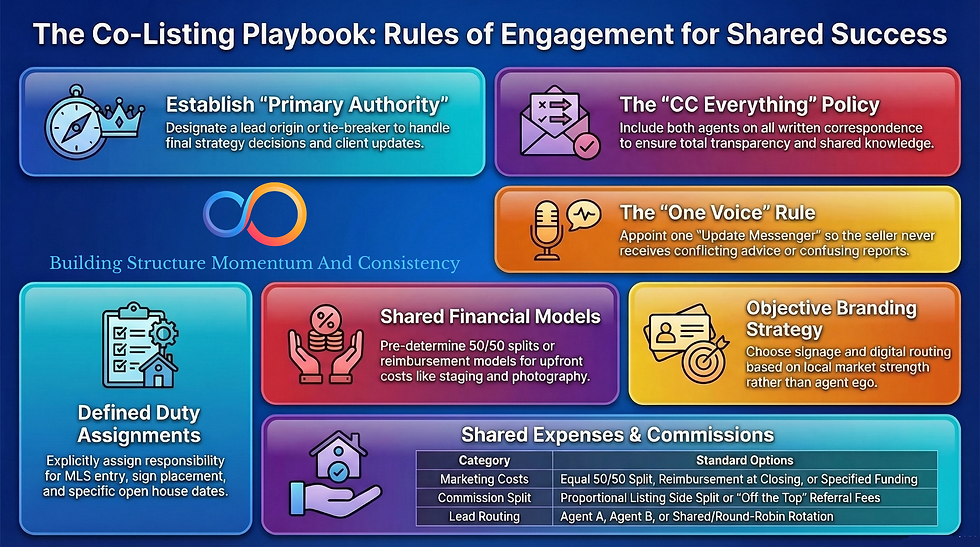
The initial excitement of a new co-listing partnership is often high. It represents a powerful opportunity to leverage individual strengths, mentor rising talent, or effectively manage high-end inventory. However, beneath that initial enthusiasm lies a significant risk: without a clear system, a co-listing is the fastest way to lose a friendship or a client. To succeed, agents must move beyond a "handshake and hope" mentality and implement a framework built on three pillars: Structure, Momentum, and Consistency.
1. The "One Voice" Rule and the Power of the Lead Negotiator
The most common friction point in a partnership is not a lack of effort, but a lack of coordination. When two agents are involved, the risk of delivering conflicting advice to the client increases exponentially. As a strategist, I advocate for the "One Voice" rule to maintain professional consistency.
Per Section 1 of the "Rules of Engagement" Agreement, partners must establish a hierarchy for client communication by designating an "Update Messenger." This ensures the seller receives a single, coherent narrative. Furthermore, Section 5 introduces a critical tactical layer: the Lead Negotiator. Professional standard dictates that one agent be designated to handle all verbal and written negotiations with buyer agents. This prevents the primary agents from being "played" against one another by a savvy buyer's representative and ensures the strategy remains airtight. Finally, the agreement must identify who holds the "tie-breaker" vote on listing strategy, whether it is the lead-originating agent or a broker, to prevent strategic deadlocks that kill momentum.
"The most common complaint from sellers in a co-listing is confusion."
2. Radical Transparency Through the "CC Everything" Policy
Assumed knowledge is the enemy of a professional partnership. To maintain trust and operational efficiency, agents should adopt a strict "Transparency Clause" as outlined in Section 5 of the agreement.
This policy dictates that both agents must be included in all written correspondence, including emails and texts to the seller or updates from title companies. If a buyer's agent calls one partner directly, that partner is professionally obligated to provide a summary of the conversation in a group text to the other immediately. This isn't just about oversight; it’s about protecting the relationship. Being "out of the loop" during a client interaction is a professional embarrassment that undermines the consistency of the team.
3. Solving Marketing Friction with the "Equal Split" Model
Financial disagreements regarding upfront expenses, such as staging, drone photography, and high-end video, can quickly sour a partnership, especially if a listing takes several months to sell. Data shows that once expenses cross the $2,000 threshold, friction points multiply.
While the "Reimbursement Model" (where one agent pays upfront and is reimbursed at closing) is common, it is strategically inferior. It allows one agent to carry a heavy financial burden while the other has less at stake. The strategist’s choice is the Equal Split model (Section 3), where costs are split 50/50 and paid as incurred. This ensures both parties have "skin in the game" from day one. It aligns motivations and ensures that every marketing decision is a mutual investment rather than a point of resentment.
4. Branding for the House, Not the Ego
Branding is a frequent source of conflict, yet it is the area where agents must be the most objective. Per Section 2 of the agreement, the choice of yard signage should be a strategic decision based on what will best serve the property’s marketability.
If one agent possesses a luxury-specific brand or a massive local following, you lead with their signage to capture maximum value. However, the non-sign agent should not be invisible. The tactical solution is the use of Sign Riders to maintain professional presence without cluttering the main brand. Decisions regarding sign calls and digital lead routing must be documented early to ensure that lead ownership is never a guessing game.
"The goal is to sell the house, not just the agent."
5. The "Graceful Exit" – Planning the Breakup Early
Not every partnership is destined to reach the closing table. Whether due to a lack of results or a change in professional circumstances, you must plan for a "Graceful Exit" long before the relationship becomes strained.
Section 7 of the agreement is your professional necessity. It pre-determines how an agent will be compensated if they withdraw, specifically outlining whether they receive a referral fee or a flat reimbursement for marketing expenses and hours invested. Treat these terms like an Insurance Policy: you hope you never need to trigger the rules, but the mere existence of the structure often prevents the fight from happening in the first place because expectations are clear from the start.
Conclusion: Structure as the Foundation for Momentum
The difference between a successful co-listing and a failed partnership rarely comes down to talent; it comes down to the quality of the system. By establishing clear rules regarding communication authority, financial "skin in the game," and branding, agents create the stability necessary for Structure, Momentum, and Consistency.
As you look toward your next partnership, ask yourself: Is your business protected by a formal "Rules of Engagement" agreement, or are you operating on a handshake and a hope?
Do you need help building Structure Momentum and Consistency?

Comments